Corn vs Wart Explained: Causes, Treatment, and Easy Identification Tips
Learn the complete Corn vs Wart comparison, including causes, symptoms, treatment options, prevention strategies, and easy ways to identify the difference quickly


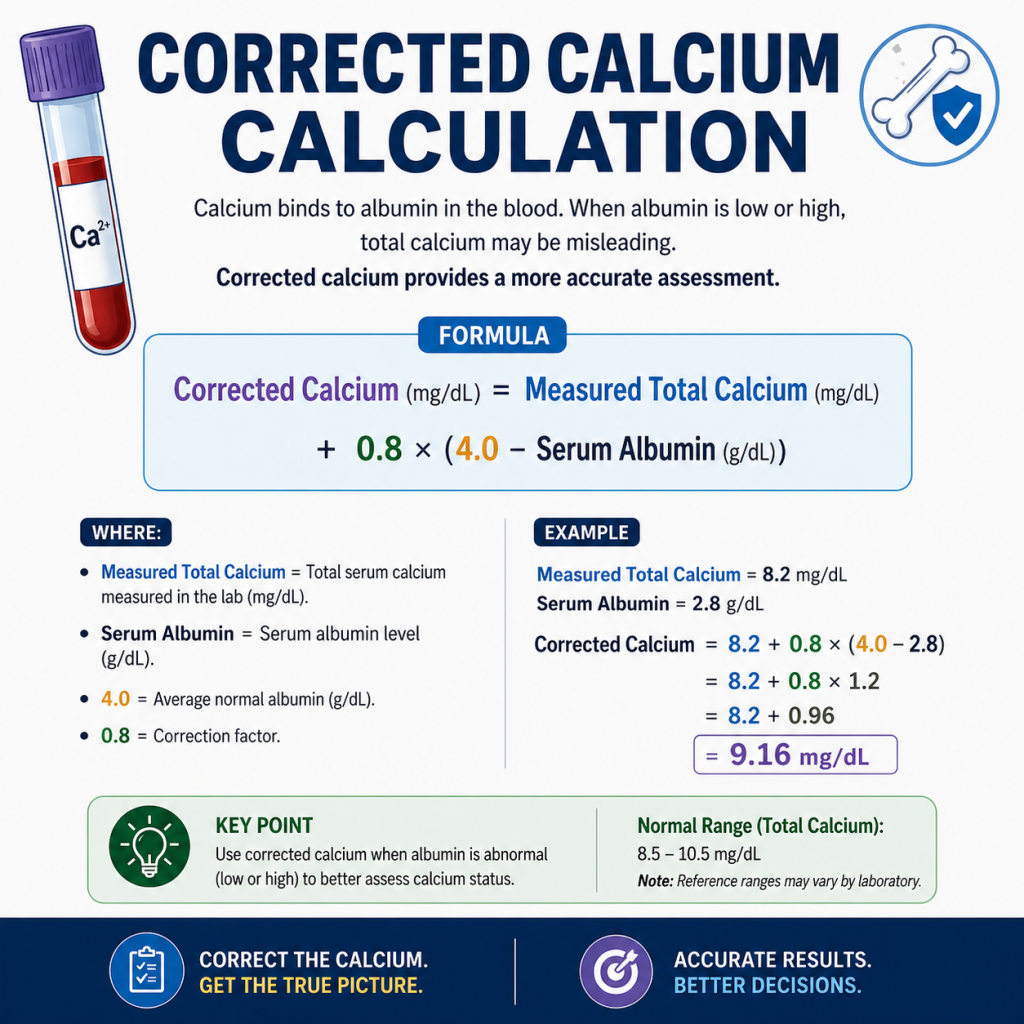
Learn the Corrected Calcium Calculation formula, how it works, and avoid common mistakes with this simple clinical guide for accurate calcium level interpretation
Calcium is one of the most important minerals in the human body, playing a vital role in bone health, nerve function, and muscle contraction. However, measuring calcium levels in the blood isn’t always straightforward. That’s where the Corrected Calcium Calculation becomes essential.
If you rely only on total serum calcium, you may misinterpret a patient’s true calcium status—especially when albumin levels are abnormal. This comprehensive guide explains the Corrected Calcium Calculation, the formula behind it, why it matters, and how to avoid common mistakes.
Table of contents [Show]
Corrected calcium refers to an adjusted calcium value that accounts for abnormal albumin levels in the blood. Since a large portion of calcium binds to albumin, low or high albumin can distort total calcium readings.
The Corrected Calcium Calculation helps estimate what the calcium level would be if albumin were within a normal range.
Understanding the Corrected Calcium Calculation is crucial for:
Without using the Corrected Calcium Calculation, clinicians may incorrectly diagnose hypocalcemia or hypercalcemia.
The most commonly used formula is:
Corrected Calcium (mg/dL) = Measured Calcium + 0.8 × (4.0 − Serum Albumin)
This Corrected Calcium Calculation adjusts calcium values to reflect a more accurate physiological state.
Let’s break it down:
Corrected Calcium Calculation:
8.5 + 0.8 × (4.0 − 2.5)
= 8.5 + 0.8 × 1.5
= 8.5 + 1.2
= 9.7 mg/dL
Even though the measured calcium looks low, the Corrected Calcium Calculation shows a normal level.
The Corrected Calcium Calculation is especially useful when:
In these cases, relying solely on total calcium can be misleading.
To fully understand the Corrected Calcium Calculation, you need to compare calcium types:
While ionized calcium is more accurate, it’s not always available. That’s why the Corrected Calcium Calculation is widely used.
Even though the formula is simple, errors are common. Here are key mistakes to avoid:
Failing to use the Corrected Calcium Calculation when albumin is abnormal can lead to incorrect conclusions.
Always ensure calcium is in mg/dL and albumin in g/dL when applying the Corrected Calcium Calculation.
The Corrected Calcium Calculation may not be accurate in critically ill patients or those with severe acid-base disorders.
Sometimes ionized calcium testing is still necessary despite using the Corrected Calcium Calculation.
While helpful, the Corrected Calcium Calculation has limitations:
Because of these limitations, clinicians should interpret results carefully.

The Corrected Calcium Calculation is widely used in:
Helps determine if low calcium is real or due to low albumin.
Prevents overdiagnosis when albumin is elevated.
Essential in kidney disease and liver disorders.
Quick assessment when ionized calcium is unavailable.
Follow these steps:
Using the Corrected Calcium Calculation correctly ensures better diagnostic accuracy.
To use the Corrected Calcium Calculation effectively:
The Corrected Calcium Calculation is useful for:
It is a fundamental concept in clinical medicine.
Imagine a patient with liver disease:
Without the Corrected Calcium Calculation, you might diagnose hypocalcemia. But after correction, calcium may be normal—avoiding unnecessary treatment.
Albumin levels fluctuate due to illness, hydration, and nutrition, affecting the Corrected Calcium Calculation.
Some institutions use different coefficients, but the standard Corrected Calcium Calculation remains widely accepted.
No. The Corrected Calcium Calculation is an estimate and may not replace ionized calcium testing.
It works best in stable patients but has limitations in critical care.
Because calcium binds to albumin, affecting total calcium levels and requiring the Corrected Calcium Calculation.
The Corrected Calcium Calculation is a simple yet powerful tool that helps avoid misinterpretation of calcium levels. By adjusting for albumin, it provides a clearer picture of a patient’s true calcium status.
However, like any medical formula, it must be used carefully and in the right context. Understanding its benefits, limitations, and proper application will help you avoid costly mistakes and improve clinical decision-making

Learn the complete Corn vs Wart comparison, including causes, symptoms, treatment options, prevention strategies, and easy ways to identify the difference quickly
Discover the best Baby Acne Treatment methods, including safe home remedies, causes, symptoms, prevention tips, and expert advice for clearing infant acne fast.
Learn everything about Facet Arthropathy, including symptoms, causes, diagnosis, and the best treatment options for managing spinal joint pain and improving mobility